.png)

Krabi : The secret is out Why Developers Are Quietly Making Their Move on Krabi
Discover why Krabi is emerging as Thailand's next property hotspot and why freehold condos are attracting foreign investors.


The Secret Is Out: Why Developers Are Quietly Making Their Move on Krabi
For years, Krabi was the Andaman coast's best-kept secret. Everyone visited — the limestone cliffs, the long-tail boats, the postcard beaches at Ao Nang and Railay — but almost nobody thought to invest. It was the place you flew into on the way to somewhere else. That era is ending, and the developers who watch these markets for a living are already making their move. Quietly, deliberately, and ahead of the crowd.
Here's why the smart money is turning toward Krabi — and why the freehold condominium, of all things, is the asset at the centre of it.
Krabi is no longer a day trip. It's a destination.
The clearest signal that a resort market has come of age is its airport, and Krabi's tells the story plainly. Krabi International Airport (KBV) has just completed a major expansion that doubled its capacity to around eight million passengers a year, with a new third terminal bringing all arrivals and departures under one roof — a project delivered by Thailand's Department of Airports as part of the national infrastructure push. Airports of Thailand has gone further still, with plans on the table to lift the airport toward twelve million passengers in the years ahead. Airlines have responded: new international services from carriers including Etihad, IndiGo and Scoot have opened direct routes into Krabi that simply didn't exist a few years ago.
That capacity is being filled. Ao Nang alone drew more than two million visitors in 2024, with Railay and the Phi Phi islands — gateway-served by Krabi — pulling well over a million more between them. The Tourism Authority of Thailand has put Krabi firmly in its national spotlight, co-hosting its 2025 Global Meaningful Travel Summit partly in the province and showcasing the "Krabi Model" as its template for sustainable, high-value tourism. This is no longer a quiet corner of the Andaman. It is one of the destinations Thailand is actively building its future tourism strategy around.
And critically for investors, that tourism translates into occupancy. Hotel occupancy across the southern Andaman beach markets — Phuket, Krabi, Samui and Phang Nga — reached roughly 79% in 2025, up from 75% a year earlier, according to regional industry research, with demand spread across both short-stay holidaymakers and longer-staying visitors. Krabi isn't just busy in February. It works year-round.
Why developers are turning here now
The logic behind the move is straightforward once you see it.
Phuket, an hour and a half up the coast, has spent two decades being built out. It is denser, pricier, and — as recent enforcement around nominee-company villa ownership has shown — increasingly complicated for foreign buyers. Samui is structurally supply-capped by building-height limits and controlled airlift. Against that backdrop, Krabi stands out as the Andaman's last genuinely underbuilt premium coastline: the same turquoise water and dramatic scenery, a fast-maturing airport and tourism base, and a fraction of the development density. For a developer, that combination — proven demand, rising access, and room to actually build — is exactly the gap worth moving into early.
But there's a second reason Krabi is so compelling right now, and it's the one most buyers completely miss.
No new freehold condos in over five years
Look closely at the Krabi market and a striking fact emerges: no new freehold condominium project has launched here in over five years.
While villas and houses have continued to be built across Ao Nang and Nong Thale, the genuine freehold condo — the single simplest, cleanest way for a foreign buyer to own property outright in Thailand — has effectively been absent from the new-build pipeline. The freehold condos that do exist were largely delivered in the 2018–2020 window, and almost all of them are now sold out and tightly held by owners who have no reason to let go. The resale market for them is thin to the point of scarcity; at any given moment, only a handful of genuine freehold units trade across the whole area.
That is an extraordinary supply position. A destination with surging visitor numbers, a doubled-capacity airport, year-round occupancy approaching 80% — and essentially zero new freehold condo supply for half a decade. Demand has kept climbing while this specific, in-demand product has flatlined at zero. In any market, that imbalance only resolves one way.
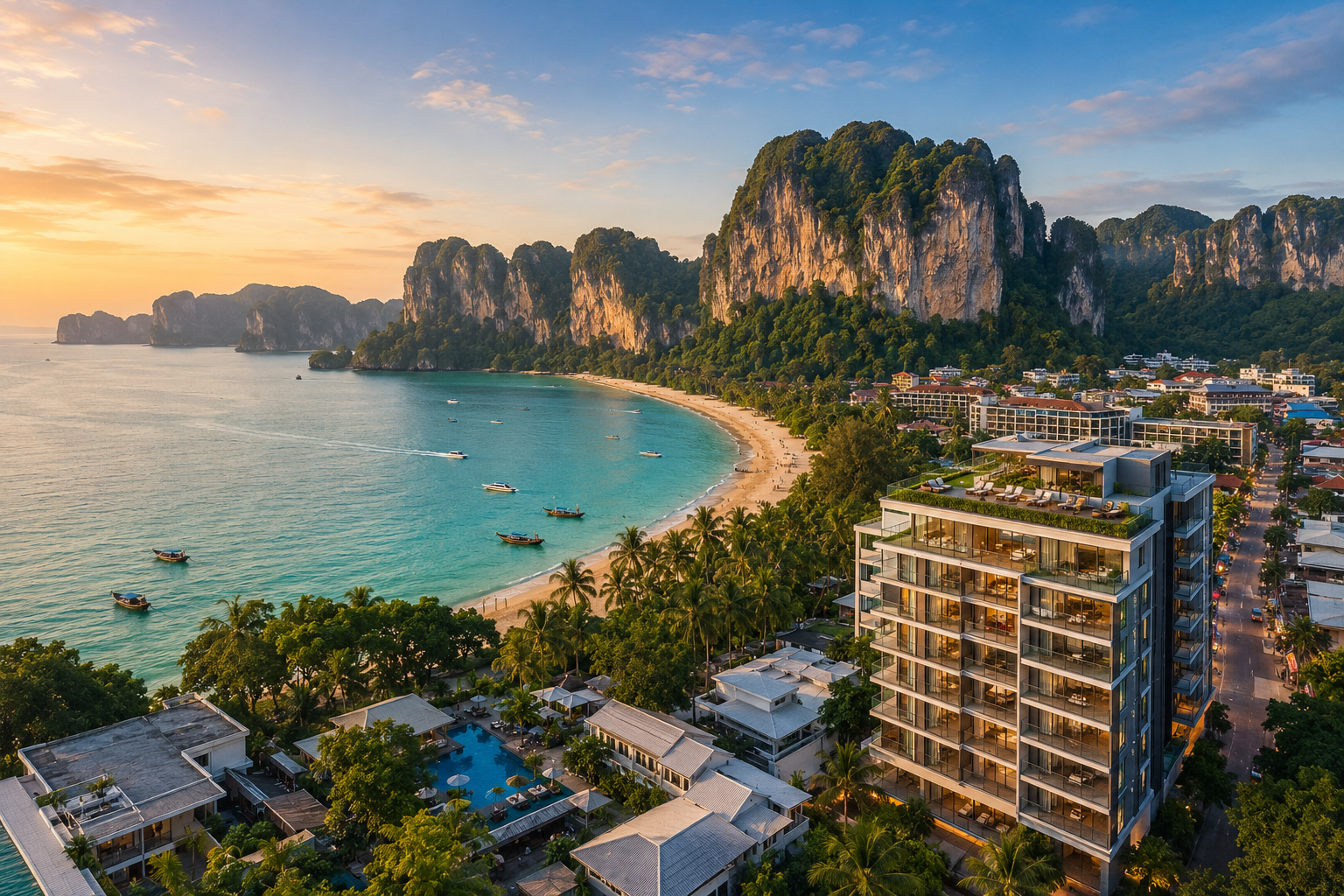
And the ones that exist rent exceptionally well
Here's the part that turns scarcity into a genuine investment case rather than a curiosity: Krabi's existing freehold condos don't just hold their value — they perform.
Because supply is so limited and tourism so relentless, owners enjoy pricing power in both rental channels at once. Short-term holiday demand is fed by Ao Nang's millions of annual visitors and the southern Andaman's ~79% occupancy, keeping nightly rates strong through the long November-to-April high season and well beyond it. Long-term demand comes from the steady base of expats, retirees, remote workers and seasonal long-stayers who increasingly choose Krabi's lower density and lower cost of living over Phuket's. The result is that a well-located freehold condo here tends to stay occupied and stay profitable year-round — a rare quality in a seasonal beach market.
For context on value, Krabi's existing freehold condo stock from the 2018–2020 era has changed hands in roughly the THB 120,000–160,000 per square metre range — a meaningful discount to comparable Phuket product, for a market with arguably stronger scarcity dynamics. Buyers are getting Andaman-coast freehold ownership at a price point Phuket left behind years ago.
The window is open — but it won't stay that way
The reason developers are moving on Krabi now, rather than waiting, is that the gap is visible and it is closing. The first genuine new freehold condominium supply to reach this market in over five years will land into a pool of pent-up, under-served demand — buyers who want clean, simple, freehold ownership on the Andaman coast and have, until now, had almost nothing new to buy.
The secret is out. The infrastructure is in. The tourism is proven. And the one asset class that lets a foreign buyer own here outright has been missing from the shelves for years. That is precisely the kind of setup that rewards the people who move before it becomes obvious to everyone else.
Angel Real Estate is actively tracking the Krabi market and the next generation of freehold opportunities on the Andaman coast. To be among the first to hear about genuine freehold condominium availability in Krabi, speak to our team.
Sources: Tourism Authority of Thailand and Ministry of Tourism and Sports (visitor arrivals and tourism strategy); Department of Airports and Airports of Thailand (Krabi International Airport expansion); regional hospitality occupancy research for southern Thailand. Freehold supply and resale pricing reflect Angel Real Estate's on-the-ground market analysis of the Krabi/Ao Nang area.
Subscribe to our newsletter
Stay up to date with Angel RE news and pre launch offers