.png)

Sap-Ing-Sith Explained: A Simple Guide for Foreign Buyers
Learn how Sap-Ing-Sith works in Thailand, its benefits, costs, and how it compares with traditional leasehold.

Sap-Ing-Sith Explained: A Simple Guide for Foreign Buyers
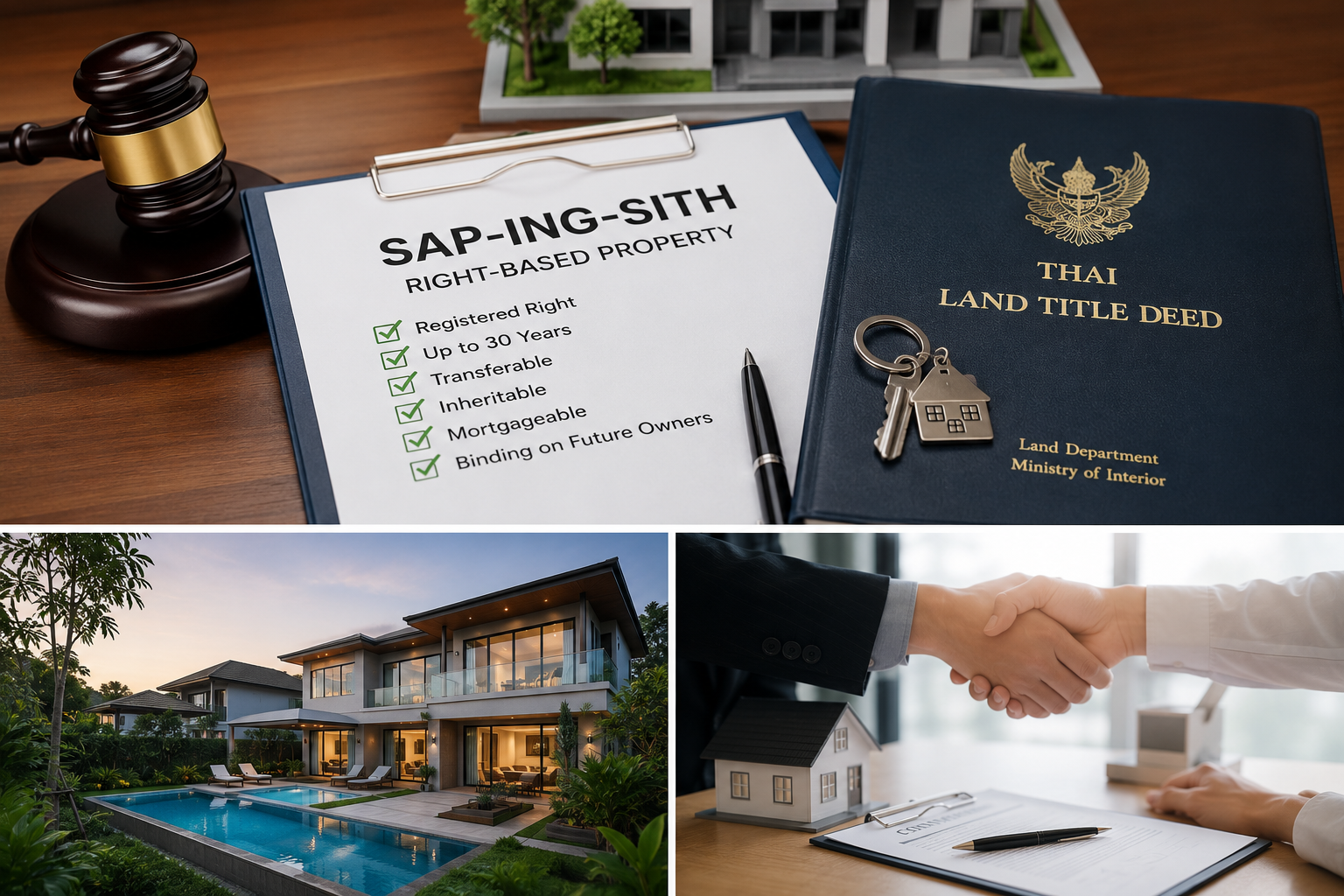
If you're looking at property in Thailand, you'll likely come across the term Sap-Ing-Sith. It's a legal ownership structure introduced in 2019, and it's becoming the preferred alternative to traditional leasehold for foreigners who want to hold land or a house long-term.
This guide explains what it is, how it works, what it costs, and how it compares to a standard leasehold.
What Is Sap-Ing-Sith?
Sap-Ing-Sith (translated as "right-based property") is a registered legal right to use land, a building, or a condo unit for up to 30 years.
The key difference from a lease: Sap-Ing-Sith is registered directly on the property's title deed at the Land Department. This makes it a real right, not just a private contract between two people. That distinction matters — it's the reason Sap-Ing-Sith holders get protections a normal lease can't offer.
How It Works
- Registered on the title deed at the Land Department — not just a paper agreement between buyer and seller.
- Term of up to 30 years, fixed at registration.
- Transferable — you can sell or transfer your Sap-Ing-Sith right to someone else without needing the landowner's permission.
- Inheritable — it passes to your heirs automatically under Thai inheritance law.
- Mortgageable — it can be used as collateral for a loan.
- Binding on future owners — if the landowner sells the land, dies, or the land changes hands in any way, your right still stands. It's attached to the property, not to the person who granted it.
- No automatic renewal — like a lease, the maximum term is 30 years. Continuing past that requires a brand-new registration and the landowner's agreement at the time. Any "30+30" promise is a contractual arrangement, not a guaranteed legal right.
Protection Against Value Drain
One of the biggest downsides of a traditional leasehold is that the property's value erodes as the term counts down — a lease with 5 years left is worth far less than one with 25 years left, since the next buyer is really only getting the years that remain.
Some developers get around this by including a contractual right to sell the property as freehold to a Thai individual or company, with the land transferred at no extra cost at the point of sale. This means the property can retain its full value even as the Sap-Ing-Sith term counts down, because a Thai buyer can pick it up as outright freehold. Not every developer offers this, so it's worth confirming whether a specific project includes it before treating it as a given.
The Costs
- Registration fee (Land Department) - 20,000 THB flat fee
- Stamp duty - 0.5% of the declared consideration paid for the right
- Withholding tax - 1% flat if the landowner is a company; progressive scale if the landowner is an individual
- VAT - 7%, if the grantor (landowner) is a VAT-registered business
These are paid at the Land Department on the day of registration. Exact figures can vary slightly by project and by how the transaction is structured, so always confirm final numbers before signing.
Note for new-build properties: many developers include some or all of these transfer costs in the sales price, rather than charging them separately at registration. This varies project to project, so it's worth confirming exactly what's covered before comparing prices between developments.
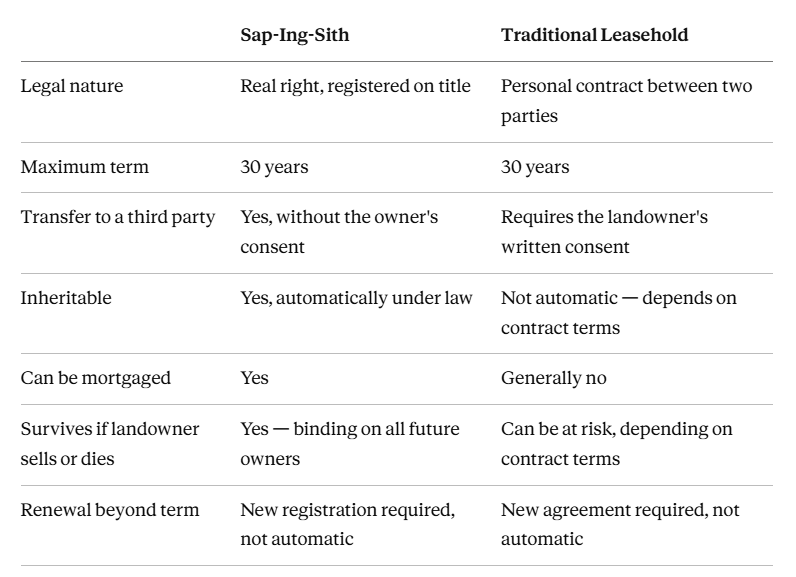
Sap-Ing-Sith vs. Traditional Leasehold
The Bottom Line
Both structures max out at 30 years, and neither guarantees automatic renewal — that part is the same. Where Sap-Ing-Sith pulls ahead is everything that happens during those 30 years: you can sell it, mortgage it, or pass it to your heirs without needing anyone's permission, and your right doesn't disappear if the landowner's circumstances change. A leasehold depends much more heavily on the goodwill and stability of the person who granted it.
For buyers who want long-term certainty without setting up a Thai company, Sap-Ing-Sith is currently the strongest legal alternative on the market.
This article is general information and not legal advice. Speak with our team to confirm how Sap-Ing-Sith applies to a specific property.
Subscribe to our newsletter
Stay up to date with Angel RE news and pre launch offers