.png)

The End of the Nominee Era: Why Sap-Ing-Sith Is Becoming Thailand's Smartest Way to Own
Discover why Sap-Ing-Sith is replacing nominee companies as a legal property ownership option for foreign buyers in Thailand.


The End of the Nominee Era: Why Sap-Ing-Sith Is Becoming Thailand's Smartest Way to Own
For the best part of two decades, there was an unofficial answer to the question every foreign buyer asks in Thailand: how do I own the land under my villa? The answer was the "Thai company" — a limited company holding the land, with Thai nationals listed as majority shareholders on paper and the foreign buyer holding the real control. It was common, it was widely sold, and for years it was treated as simply how things were done.
In 2026, that answer has stopped working. The nominee structure is being dismantled in real time — and as it collapses, a quieter, fully legitimate alternative is stepping into its place. It's called Sap-Ing-Sith, and the smart money is moving toward it fast.
Why nominees are now under serious threat
This isn't a rumour or a future risk. The crackdown is already here, it is well resourced, and it is producing real consequences.
Thailand's Department of Business Development has shifted from passive registration to active enforcement, using data analytics to flag companies with the tell-tale signatures of nominee arrangements — Thai shareholders with no genuine source of funds, no real business activity, and a foreign director in full control. The numbers being scrutinised are not small. In the southern resort provinces in particular, tens of thousands of companies have been pulled in for review, with a very large share of all registered firms on the most popular islands now under the microscope. Dedicated provincial operations have been stood up specifically to target property-holding structures, and hundreds of companies have already been prosecuted, with authorities citing billions of baht in estimated economic damage.
Two regulatory changes in 2026 sharpened the blade. New rules now require companies to prove the genuine source of funds behind their Thai shareholders — the single hardest thing for a nominee arrangement to do, because the whole point of the structure is that the Thai shareholders never actually paid for their shares. That one requirement quietly invalidates the foundation most of these companies were built on.
And the consequences for getting caught are severe. A non-compliant structure can face company dissolution, financial penalties, criminal liability for everyone involved — including the Thai nominees — and forced sale of the property. Worse still for buyers, the direction of travel is only getting harder: a proposed amendment to the Land Code under study would introduce outright forfeiture, removing even the financial exit that today's rules still leave open. Right now, a forced sale at least returns your capital. Tomorrow's rules may not.
The takeaway is simple. The nominee company was always a grey-area workaround. In 2026 the grey has gone, and what's left is a structure that ranges from legally fragile to outright dangerous. Buyers across the country are already pausing villa purchases until they understand what they're actually being sold.
That pause is exactly where Sap-Ing-Sith comes in.
What Sap-Ing-Sith actually is
Sap-Ing-Sith (ทรัพย์อิงสิทธิ) is a registrable property right introduced under the Sap-Ing-Sith Act B.E. 2562 (2019). In plain terms, it gives the holder — including a foreigner — the right to use and benefit from a specific property for a fixed term of up to 30 years, registered directly against the title deed at the Land Office, with a certificate issued in the holder's name.
What makes it powerful is one legal distinction that sounds technical but changes everything: Sap-Ing-Sith is a real right (a right in rem), not a personal contract. A standard lease is a private agreement between two people — fragile, tied to the relationship, and limited in what it lets you do. A real right attaches to the property itself and is enforceable against the world, including any future owner, creditor or heir of the land. Your name goes on the title. The right is yours, recognised by the state, for the full term.
It can be applied to Chanote-titled land, to buildings on that land, and to condominium units.
Why it's becoming increasingly popular
As the nominee route closes, buyers and developers are discovering that Sap-Ing-Sith offers most of what people actually wanted from "ownership" — without the legal exposure. Four features in particular are driving its rise:
It's freely transferable. You can sell or assign your Sap-Ing-Sith right to a third party without needing the landowner's consent. That liquidity is something a standard lease, with its renewal-at-the-owner's-discretion structure, simply can't match.
It's inheritable. The right passes through your estate to your heirs — including foreign heirs — under Thai inheritance law. For buyers thinking about legacy, retirement, or simply protecting their family, this is a decisive advantage over instruments like usufruct, which die with the holder.
It can be mortgaged. The right can be used as security for financing, opening up possibilities that personal leases don't.
It's registered and secure. Because it binds the property and sits on the title, it survives a change of landowner and is enforceable in its own right. It is, by some distance, the strongest ownership-style structure available to a foreigner short of outright freehold — and, crucially, it is completely legal and transparent, the polar opposite of a nominee arrangement.
Put simply: where the nominee company gave you control through a structure the authorities are now tearing down, Sap-Ing-Sith gives you registered, defensible rights through a structure the authorities created on purpose.
Sap-Ing-Sith vs traditional leasehold: the real difference
Most foreigners who can't own land outright are offered a standard 30-year lease. On the surface, the two instruments look similar — both run for up to 30 years, and neither comes with a guaranteed right of renewal. But that's where the resemblance ends. The difference isn't the length of the right; it's the strength of it. A registered lease is one of the weakest positions you can hold in Thai property. Sap-Ing-Sith is one of the strongest short of freehold.
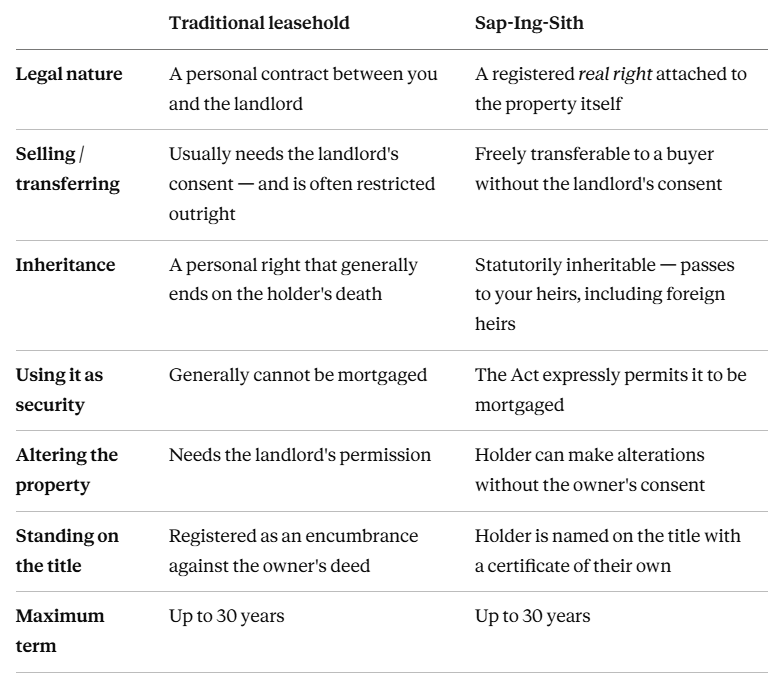
The two rows that matter most to an investor are transfer and inheritance. With a lease, your exit depends on a landlord's cooperation, and your heirs can be left with nothing. With Sap-Ing-Sith, you can sell to whomever you choose without asking anyone's permission, and you can pass the right to your family as a matter of law. That is the difference between holding a fragile promise and holding a registered asset — and it's the single biggest reason that buyers who've done their homework are now choosing Sap-Ing-Sith over a conventional lease.
The honest caveats — because they matter
Any agent who sells you Sap-Ing-Sith as "the same as freehold" is overselling it, and the credibility of this whole approach depends on being straight about its limits.
It is not outright ownership of the land. The maximum term is 30 years, and the Act provides no automatic statutory right of renewal. You may see projects marketed with "30+30" or "30+30+30" terms — treat these with care. Thailand's Supreme Court has reaffirmed that pre-agreed renewal promises designed to circumvent the statutory cap are contractual, not guaranteed property rights. A renewal can be negotiated and documented, but it is a promise, not a certainty.
None of this makes Sap-Ing-Sith weak — a registered, transferable, inheritable real right for 30 years is a genuinely strong position. It simply means the structure has to be set up properly, with the renewal terms, building ownership and exit provisions drafted carefully from the outset. This is exactly why the partner you do it with matters as much as the structure itself.
Where it fits — and the cleaner option alongside it
For a foreign buyer who wants a villa or a landed home, Sap-Ing-Sith is fast becoming the leading legitimate route, because foreigners cannot own land outright and the nominee alternative is now off the table. For condominium buyers, there are two clean paths: straightforward freehold ownership within a project's 49% foreign quota where it's available, and Sap-Ing-Sith where the freehold quota is already full or where a buyer simply prefers a registered long-term right. The two work together, and between them they cover almost every buyer's needs — legally, transparently, and with full protection.
The bigger picture
What's really happening in 2026 is a maturing of the entire market. Thailand is moving away from the informal, grey-area structures that defined foreign property ownership for twenty years, and toward registered, defensible, transparent rights. The nominee company is the past. Freehold condos and Sap-Ing-Sith are the future. The buyers who recognise that early — and structure their purchases the right way — are the ones who'll own with confidence while others are still untangling what they signed.
The secret to owning in Thailand was never a clever workaround. It's choosing the right structure, and the right people to put it in place.
Angel Real Estate structures Sap-Ing-Sith and freehold purchases for foreign buyers across Thailand — legally, transparently, and built to protect your investment for the long term. Talk to our team about the right ownership route for you.
Sources: Sap-Ing-Sith Act B.E. 2562 (2019), Thailand; Department of Business Development enforcement activity and 2026 source-of-funds regulations; Thai Supreme Court rulings on lease and renewal enforceability. This article is general information, not legal advice.
Subscribe to our newsletter
Stay up to date with Angel RE news and pre launch offers