
The Architecture of the Kitchen: How Thailand’s Agrifood Engine Fuels Real Estate Market
Thailand’s agrifood growth is driving demand for industrial, logistics, and cold-chain real estate investments.

The Architecture of the Kitchen: How Thailand’s Agrifood Engine Fuels Real Estate Market
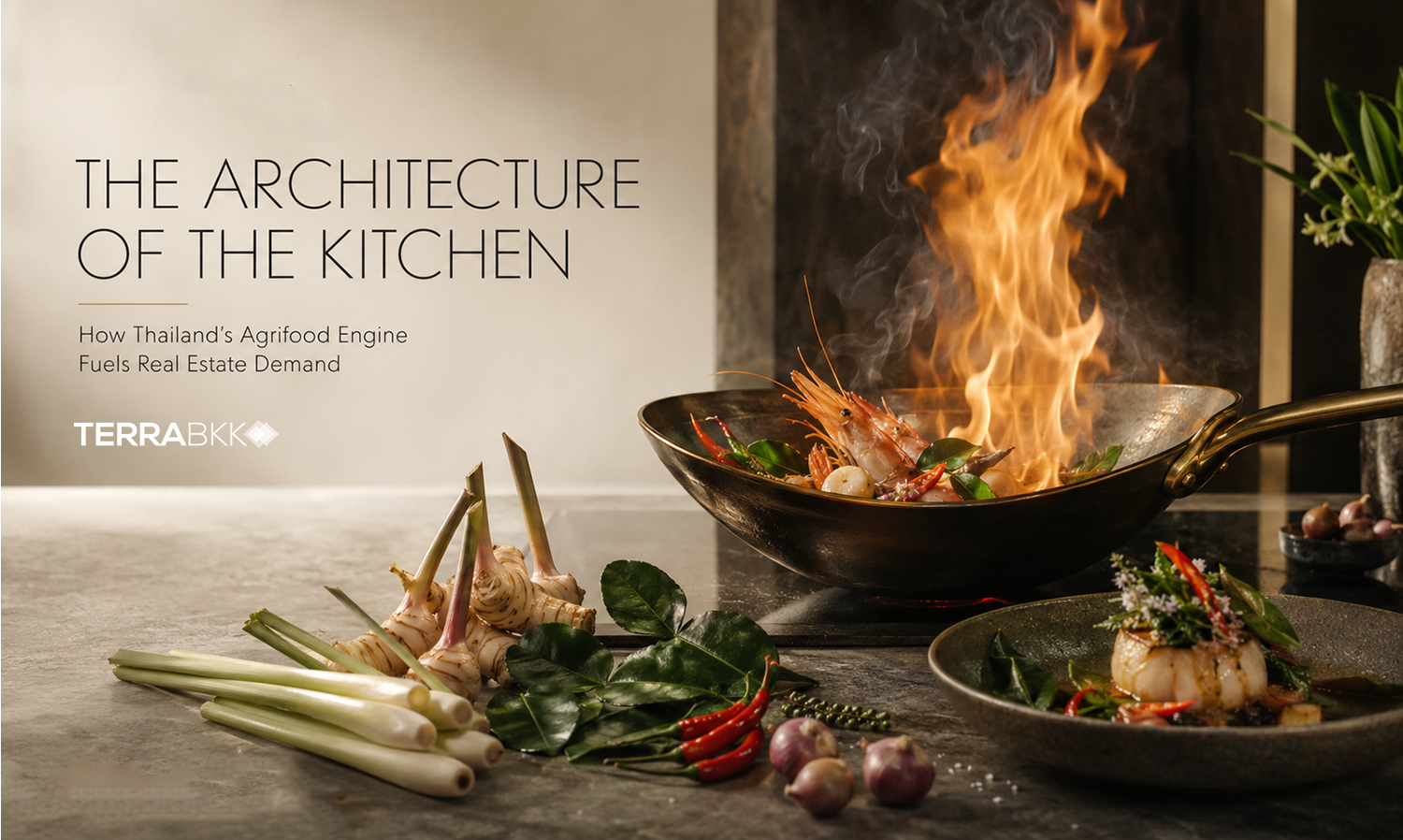
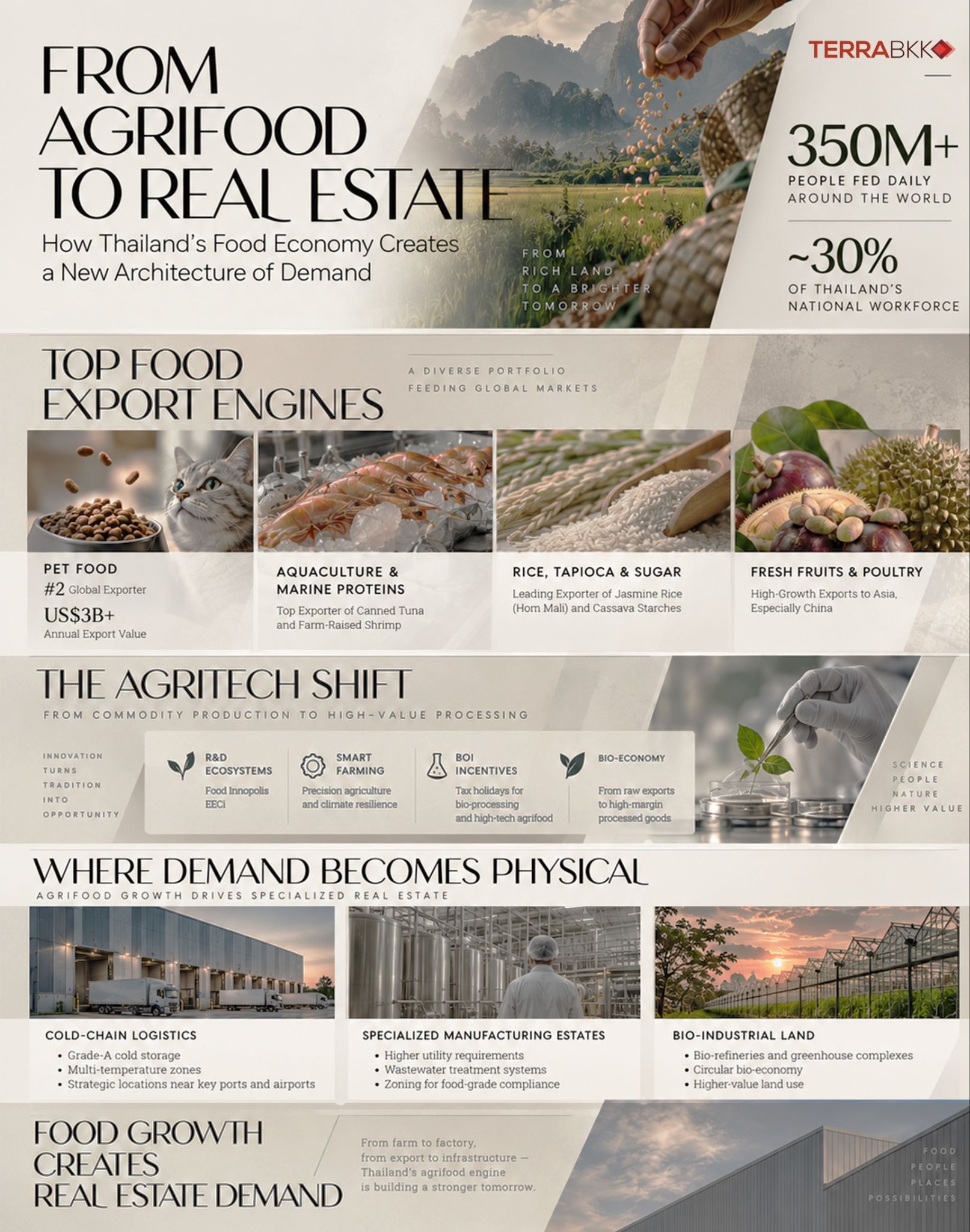
Most headlines about Southeast Asian economies often center on semiconductor manufacturing, electronic vehicles, ICE automobiles, and tourism. One of Thailand’s most resilient structural economic pillar remains quietly overlooked. Aside from being perceive as a global destination, Thailand is widely recognized as the "Kitchen of the World," which feeds over 350 million people around the world daily.
Thailand's agrifood sector is evolving from an agrarian baseline into a high-margin export engine. Crucially for institutional investors, this agrifood industrial complex acts as a key driver of structural demand for commercial real estate, logistics hubs, and specialized industrial property across the region.
1. The Agrifood Pillar of the Thai Economy
Agriculture and food processing contribute significantly to Thailand’s GDP and account for nearly 30% of the national labor force. During economic setbacks, the sector acts as an economic stabilizer, generating foreign exchange reserves when cyclical sectors like tourism face headwinds.
Under government economic policies such as the Bio-Circular-Green (BCG) model, Thailand is shifting away from exporting raw commodities. The objective is clearly obvious: enhance agricultural product value by transforming domestic raw materials into high-margin processed goods, functional foods, and bio-industrial ingredients.
2. Top Food Export Engines
Thailand’s food processing infrastructure stands out globally due to its supply chain integration, strict sanitary standards, and labor efficiency.
Pet Food (The High-Margin Star)
Thailand is the world’s second-largest exporter of pet food, behind only Germany. Reaching upwards of $3 billion in annual export value, Thai processors leverage local tuna-canning networks and poultry production to manufacture human-grade wet cat and dog food for global brands.
Aquaculture & Marine Proteins
Thailand remains a top exporter of canned tuna and farm-raised shrimp. Strong integration between marine harvests and automated processing plants allows domestic firms to navigate stringent FDA and EU food safety standards better than regional competitors.
Rice, Tapioca, & Sugar
As a leading exporter of Jasmine Rice (Hom Mali) and cassava starches, Thailand anchors regional food security. Tapioca products supply everything from global food manufacturing to industrial adhesives and bio-plastics.
Fresh Fruits & Poultry
Driven by trade agreements across Asia, exports of fresh durian, mangosteen, and processed poultry generate massive revenue. Fast, cold-chain export corridors direct to China have turned fresh fruit into one of the country's highest-yield agricultural activities.
3. The Agritech Shift: Moving Up the Value Chain
To combat rising labor costs and climate volatility, Thailand is investing in agricultural technology and high-tech bio-processing:
- R&D Ecosystems: Specialized industrial zones like Food Innopolis and the Eastern Economic Corridor of Innovation (EECi) offer regulatory sandboxes and pilot facilities for alternative proteins, novel ingredients, and smart farming.
- Incentives for Capital: Thailand’s Board of Investment (BOI) grants aggressive tax holidays for investments in smart agriculture, precision farming, and bio-refineries, drawing foreign joint ventures from Europe, Japan, and North America.
4. The Real Estate Linkage: Industrial & Logistics Synergy
The growth of Thailand’s food sector translates directly into demand for specialized industrial real estate and modern logistics assets.
Cold-Chain Logistics Infrastructure
Expanding export volumes of temperature-sensitive proteins and fresh produce are creating a deficit of Grade-A cold storage. Institutional developers are building modern facilities equipped with Automated Storage and Retrieval Systems (ASRS) and multi-temperature zones near trade hubs like Laem Chabang Port and Suvarnabhumi Airport.
Specialized Manufacturing Estates
Food processing plants have footprint requirements distinct from standard light industrial sheds:
- Heavy Utility Needs: Processing requires 3x to 4x the water supply, specialized wastewater treatment, and high-capacity steam or gas connections compared to electronics assembly.
- Location Strategy: Industrial park developers in the Eastern Economic Corridor (EEC)—covering Rayong, Chachoengsao, and Chonburi—are zoning specific zones designed for food-grade tenant compliance.
Upstream Bio-Industrial Land
The push toward a circular bio-economy is converting regional land parcels into bio-refineries and greenhouse complexes, turning lower-yield farmland into higher-yielding industrial infrastructure assets.
5. Strategic Investment Opportunities & Risks
For institutional capital, the agrifood-real estate intersection offers compelling risk-adjusted entry points:
High-Yield Institutional Plays
- Sale-and-Leaseback Deals: Partnering with established food conglomerates via sale-and-leasebacks of modern processing and distribution facilities provides steady, inflation-hedged yields backed by corporate credit.
- Speculative Cold Storage: Developing multi-tenant, modern cold-chain parks caters to mid-tier exporters who cannot afford capital-intensive logistics builds.
Structural Risks to Manage
- Resource Volatility: Water management is critical; drought risks (e.g., El Niño cycles) require industrial developers to secure dedicated water reservoirs.
- Automation Demands: Rising domestic wages mean real estate assets must accommodate heavy machinery, robotics, and high-bay automation to maintain long-term tenant profitability.
Thailand’s food and agricultural complex is far more than an export engine—it is a foundational economic driver that anchors industrial real estate, fuels logistics, and provides structural stability. For investors looking at Southeast Asia, Thailand in particular, the transition into a high-value, tech-enabled "Kitchen of the World" offers direct exposure to the region's industrial growth.
Subscribe to our newsletter
Stay up to date with Angel RE news and pre launch offers