.png)

From Holiday Escapes to Everyday Living
Bangsaen and Pattaya evolve from tourist destinations into coastal residential hubs driven by lifestyle, investment, and quality of life.

.png)
From Holiday Escapes to Everyday Living
Bangsaen and Pattaya are redefining Thailand's coastal cities, turning travel destinations into sought-after places to live, thrive, and invest for the future.
For many, a connection with a coastal city begins with a holiday. It's where people go to relax, recharge, and leave the demands of everyday life behind, even if only for a few days.
Bangsaen has long been the quintessential weekend escape for Bangkok residents—a nearby beach town with a familiar charm. Pattaya and Jomtien, on the other hand, have established themselves as international resort destinations, offering world-class hospitality, dining, retail, recreation, and amenities that welcome travelers from across the world.
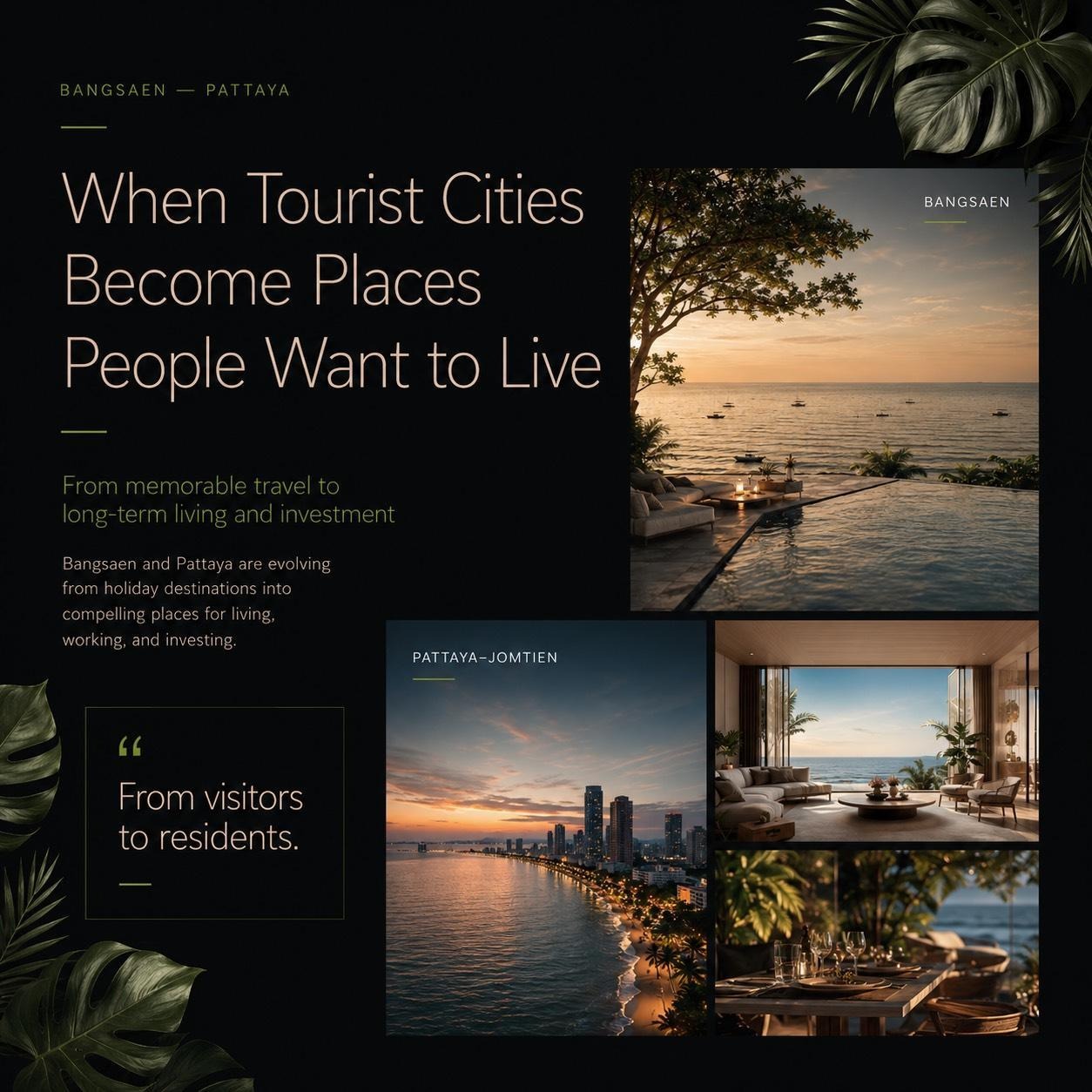
Bangsaen and Pattaya are evolving into compelling places for living and investing.
Great Tourism Cities Inspire People to Return
The true strength of a tourism city lies in its ability to give people a reason to come back. The more frequently visitors return, the more deeply they come to know the city. They begin to discover which neighborhoods are peaceful, which are vibrant, where the best restaurants are, how accessible the hospitals are, how close the schools and universities are, and whether the city can genuinely support everyday life.
This growing familiarity plays an important role in residential decision-making. Once people become comfortable with a place, renting, buying, or investing in property there becomes increasingly appealing.
Bangsaen benefits from being a coastal city that is easily accessible from Bangkok. It is equally well suited for day trips, weekend getaways, and regular visits, allowing people to gradually build a lasting connection with the city.
Pattaya and Jomtien, meanwhile, draw strength from a much broader visitor base. Beyond domestic tourists, they attract international travelers, long-stay visitors, retirees, entrepreneurs, and professionals who frequently travel to Thailand's Eastern Economic Corridor for work.
When a city succeeds in bringing people back time and again, tourism begins to create something more enduring than short-term economic activity. Some visitors gradually become renters, homeowners, or long-term residents, transforming a travel destination into a place people ultimately choose to call home.
Chonburi: One of Thailand's Largest Residential Markets
The potential of Chonburi extends far beyond its reputation as a tourism destination. It is equally reflected in the strength of its residential property market. According to Colliers Thailand, the province recorded 30,308 residential property transfers in 2025, with a total transaction value of THB 76.9 billion, making Chonburi one of Thailand's largest residential markets.
Meanwhile, data from the Real Estate Information Center (REIC) shows that in the first quarter of 2026, foreign buyers acquired 3,241 condominium units across Thailand, with a combined transaction value of THB 13.5 billion.
These figures underscore a broader shift: Thailand's coastal cities are no longer serving only as tourism destinations. They have evolved into active residential markets where property is consistently attracting buyers and residents, reflecting consistent demand that extends well beyond the tourism economy.
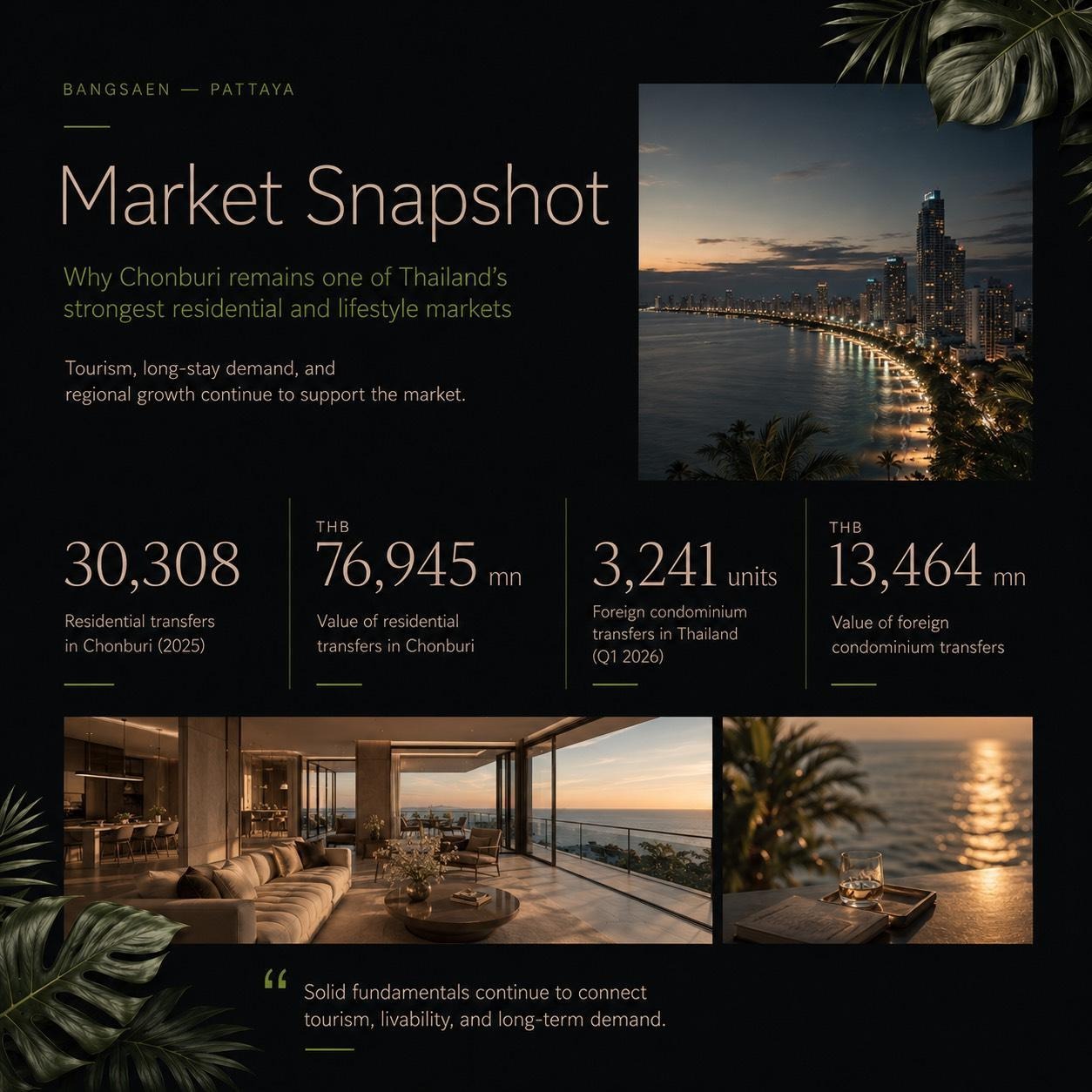
Chonburi real estate market snapshot
A Truly Livable City Needs More Than a Beautiful Beach
Although beaches may be the first thing that attracts people to a coastal city, long-term living depends on much more than scenic surroundings. Residents need access to quality healthcare, education, retail, transportation, employment opportunities, public safety, and recreational spaces that support everyday life. A city built solely around tourism may leave a lasting impression on visitors, but a city with the infrastructure and services to support daily living inspires far greater confidence for those considering a long-term future there.
Bangsaen is a strong example of a coastal city with these foundations already in place. Beyond its beaches and leisure attractions, it is home to Burapha University, hospitals, essential services, and a year-round population of students, professionals, and local residents, creating a vibrant urban environment that extends well beyond the tourism season.
Pattaya and Jomtien, meanwhile, have evolved well beyond the traditional resort-city model. Today, they offer a mature urban ecosystem that includes hospitals, international schools, shopping malls, internationally recognized dining, a diverse service economy, and a wide range of lifestyle amenities that cater to both visitors and long-term residents alike.
Bangsaen: Where a Coastal City Grows Alongside a University Town
At a glance, Bangsaen may appear to be a modest seaside town. But when taking a closer look, reveals a far more diverse and resilient base of residential demand than many people realize.
Tourists, university students, parents, faculty members, healthcare professionals, working professionals, and business owners all contribute to a year-round flow of people, creating a vibrant community that extends well beyond the holiday season.
Bangsaen's long-term appeal is underpinned by four key strengths: tourism, education, healthcare and services, and its strategic connectivity to Bangkok and the Eastern Economic Corridor (EEC). Together, these pillars support not only a thriving visitor economy but also a sustainable foundation for long-term living and residential growth.

Bangsaen benefits from four key growth drivers: tourism, higher education, healthcare, and strong connectivity to the EEC's employment hubs.
These diverse demand drivers are reshaping the city's residential landscape, transforming it from a market dominated by dormitories and low-rise housing into one that increasingly caters to permanent urban living.
Pattaya–Jomtien: From a World-Class Tourism Destination to an International Residential City
Pattaya has long been one of Thailand's most renowned tourism destinations. What is changing today, however, is that the city is no longer defined solely by short-term leisure travel.
An increasing number of visitors are choosing to stay longer. Some relocate for work, others settle into retirement, while many are seeking a second home where they can return regularly throughout the year.
These evolving lifestyle preferences have given rise to a diverse residential market, ranging from investment-oriented condominiums to premium residential developments that combine the service standards of luxury hotels with the comfort and permanence of home.
Pattaya–Jomtien's continued growth is driven by four key pillars: international tourism, the expanding long-stay and retiree market, the growing branded residences segment, and a mature lifestyle ecosystem with services and amenities that support everyday living.

Pattaya–Jomtien is expanding its role from a world-renowned tourism destination to a preferred location for long-term stays and international living.
According to the Asia Branded Residences Market Review 2026 by C9 Hotelworks, Thailand's branded residences market is valued at approximately THB 205.3 billion, representing 13.3% year-on-year growth. When both completed and pipeline developments are included, Pattaya accounts for approximately 1,775 branded residence units, underscoring its position as one of the country's leading markets for this segment.
The growth of branded residences also reflects a broader shift in buyer preferences. Increasingly, purchasers are placing greater value on professional property management, premium services, high-quality amenities, and the overall ownership experience, rather than evaluating a property solely on its sea views or price point.
Tourism and quality of life create the conditions for growth, but a residential market earns credibility through completed projects, measurable performance, and sustained development momentum.
The scale and diversity of residential developments in Bangsaen and Pattaya–Jomtien illustrate the confidence that developers and investors have in the long-term prospects of these emerging coastal residential markets.
The strength of a city is not defined by any single project. Rather, it is shaped by an urban ecosystem that enables people to live their everyday lives with convenience and confidence.
Education and healthcare support families and residents across every stage of life. Employment opportunities and economic activity provide compelling reasons for people to build their careers and lives there. At the same time, restaurants, cafés, recreational spaces, and the coastal setting contribute to a quality of life that offers a refreshing alternative to larger metropolitan areas.
When these elements come together, a city becomes more than just a place people want to visit—it becomes a place where they can genuinely see themselves living.

Quality of life, employment opportunities, and everyday amenities are the key factors that encourage people to stay longer and ultimately choose to live there.
Bangsaen–Pattaya and the Rise of Eastern Thailand's Integrated Economic and Residential Corridor
When viewed together, Bangsaen, Pattaya, Si Racha, and Laem Chabang are no longer functioning as isolated cities. Instead, they form an interconnected urban network, with each playing a distinct role in supporting the region's economy and residential growth.
Bangsaen is anchored by tourism, higher education, and healthcare.
Si Racha serves as a business hub and home to a large community of skilled professionals and expatriates.
Laem Chabang is the region's industrial, port, and logistics center.
Pattaya–Jomtien has established itself as a leading destination for international tourism, lifestyle living, second homes, and long-term residency.
This interconnected ecosystem gives people the flexibility to work in one city while living in another. For example, professionals employed in Si Racha or Laem Chabang may choose to live in Bangsaen, while business owners and executives connected to the industrial corridor may prefer to own homes in Pattaya or Jomtien, drawn by their lifestyle offerings and international-standard amenities.
Together, these cities are evolving into an integrated economic and residential corridor, where connectivity, complementary urban functions, and quality of life reinforce one another and create a more resilient model of regional growth.

Bangsaen–Pattaya forms part of a growing coastal urban corridor where tourism, economic opportunities, transportation, and residential development converge.
This growing connectivity means that Chonburi is no longer defined by a collection of separate real estate markets. Instead, it is emerging as an integrated economic and residential corridor, where cities complement one another through interconnected roles and shared growth.
As the population grows, demand naturally expands for retail, schools, hospitals, workplaces, transportation, and a broader range of everyday services. Residential development therefore becomes more than a response to urban growth—it also acts as a catalyst, attracting people, stimulating economic activity, and reinforcing the city's long-term development.
Tourism Introduces People to a City, but Quality of Life Makes Them Choose to Stay
The memories and impressions created through travel may be the starting point, but the decision to build a life in a city is shaped by much deeper factors.
People seek convenience, safety, healthcare, educational opportunities, employment options, and an environment that enables a more balanced everyday life.
This is why Bangsaen and Pattaya are not simply transforming from tourism destinations into residential cities overnight. Instead, they are gradually expanding their roles by building upon the foundations they already have.
Some visitors may return many times.
Some may begin staying for longer periods.
Some may start looking for rental homes.
Some may purchase a second home.
And some may eventually choose to make the city their true home.

A City with Long-Term Value Is More Than a Travel Destination—It Is a Place People Choose to Live
Ultimately, the strength of a tourism city may not be measured only by the number of visitors it attracts, but also by its ability to make people feel that the city is more than a temporary escape. It is a place where they can build a life, shape their future, and create lasting value over time.
From visitors to residents.
From a holiday destination to a city people choose to call home.
This may be the emerging story of Bangsaen and Pattaya—two coastal cities gradually transforming the memories created through travel into the reality of everyday living.
Subscribe to our newsletter
Stay up to date with Angel RE news and pre launch offers