
Why Thailand Is Emerging as a Preferred Data Center Hub in Southeast Asia?
Thailand is emerging as Southeast Asia’s data center hub, driven by reliable power, green energy, connectivity, and investment.

Why Thailand Is Emerging as a Preferred Data Center Hub in Southeast Asia?
While some countries in Southeast Asia has aggressively introduced tax breaks and financial incentives to lure high-tech investments, hyperscalers (such as Amazon Web Services, Google, and Microsoft) and major colocation providers consistently favor Thailand for their massive Southeast Asian data center deployments.
Financial incentives alone are rarely the decisive factor for critical infrastructure investments. Data center site selection hinges on operational risk mitigation, long-term regulatory predictability, power grid stability, and structural speed-to-market.
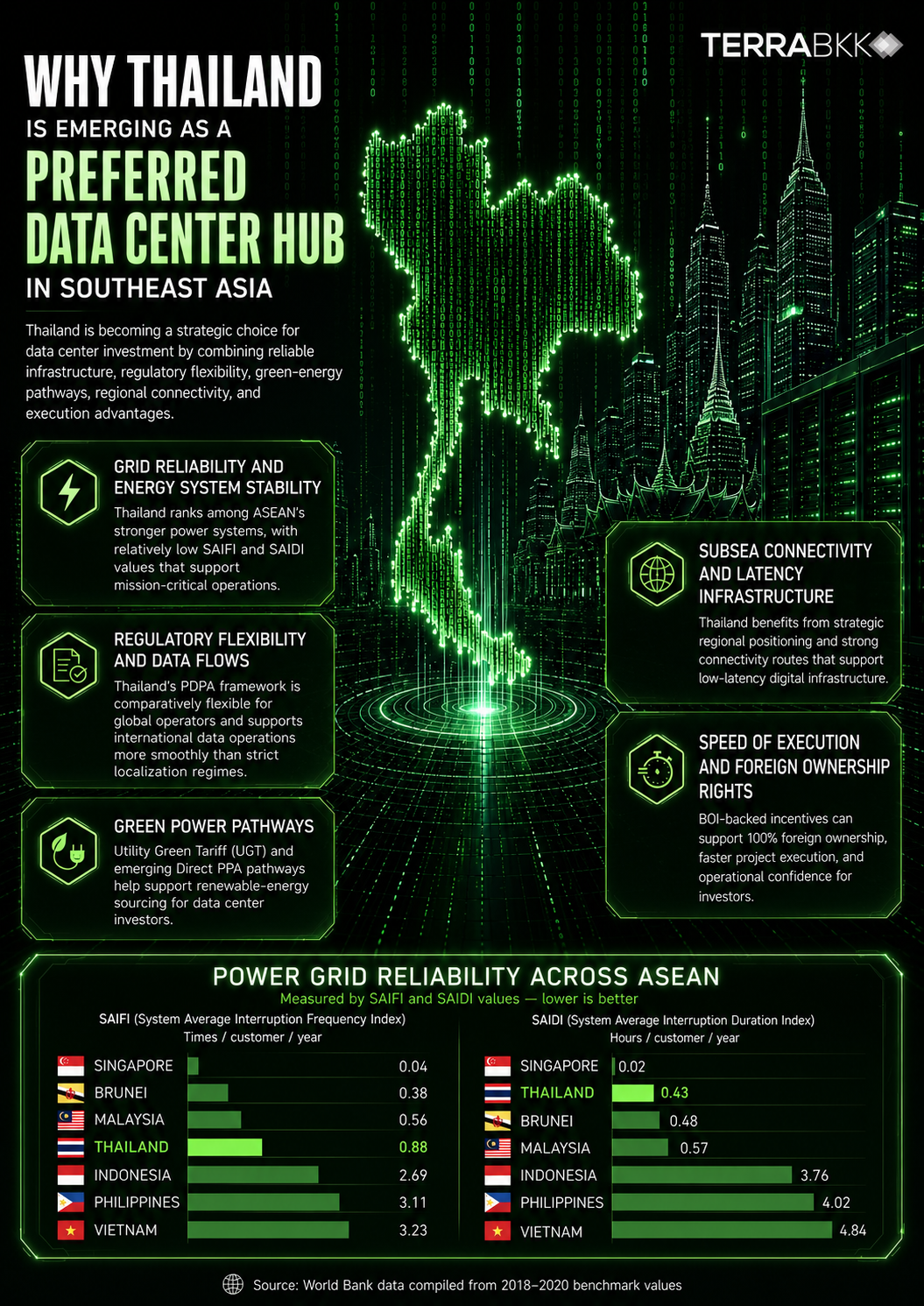
Five Key Reasons Firms Choose Thailand for Data Center
1. Grid Reliability and Energy System Stability
Data centers operate 24 hours, all year round. Frequent system downtime from various causes is intolerable. Data from World Bank showed thaiThailand’s power grid maintains low SAIDI and SAIFI scores (metrics measuring the duration and frequency of power outages). On the other hand, Vietnam, despite its vast energy potential, faces severe power shortages and grid transmission bottlenecks, particularly in industrial northern hubs where coal and hydro generation struggle to meet surge demand during dry seasons. For hyperscalers, power availability without blackouts overrides tax incentives.
2. Regulatory Flexibility vs. Strict Data Localization
Thailand’s Personal Data Protection Act (PDPA), while aligned with Europe’s GDPR, offers a far more flexible legal environment for global operators. Thailand allows full foreign ownership of data centers through Board of Investment (BOI) privileges and does not impose complex joint-venture mandates or strict data flow bans, allowing hyperscalers to integrate Thai facilities seamlessly into their global edge networks.
3. Power Sourcing and Green Energy Mandates (Utility-Scale Offtakes)
Global tech firms operate under strict RE100 commitments (100% renewable energy targets). Thailand has proactively responded by introducing Utility Green Tariffs (UGT) and Direct Power Purchase Agreements (Direct PPAs), allowing tech giants to procure clean energy (solar, wind, hydro) directly from local generators. The speed of transition to renewable energy source remains crucial in atttracting data centers to Southeast Asia.
4. Subsea Connectivity and Latency Infrastructure
Thailand functions as a central geographical bridge within continental Southeast Asia. It boasts multiple active and planned international subsea cable landings linking the Indian Ocean to the Pacific (connecting directly to Singapore, Malaysia, Hong Kong, and Japan) and linking Australia to Asia. This provides redundancy and low-latency throughput across the region. Other’s countries subsea infrastructure is often hampered by frequent cable breaks and limited redundancy, creating operational risk for global cloud providers.
5. Speed of Execution and Foreign Ownership Rights
Under Thailand’s BOI scheme, approved data center projects receive streamlined land ownership rights, expedited work permits for foreign technical talent, and 100% foreign equity allowance. Firms can secure land in various industrial estates across the Eastern Economic Corridor (EEC). Thai government invested heavily in the EEC, which resulted in power and communication infrastructure ready for supporting data centers. In some ASEAN countries, land acquisition, licensing procedures, and complex foreign ownership caps in telecom services frequently extend project development timelines by years.

Implications for the Thailand Real Estate Market
The influx of data centers investment serves as a powerful growth catalyst across multiple sectors of Thai commercial and industrial real estate:
- Explosive Demand for Industrial Land in the Eastern Economic Corridor (EEC): Data center land acquisitions require vast acreage with proximity to high-voltage power sub-stations. Industrial estate developers in provinces like Chonburi and Rayong are seeing record land absorption rates and premium pricing for "data-center-ready" plots.
- Transition from Traditional Logistics to High-Value Industrial Assets: Land developers are pivoting away from standard warehouses to build custom, power-connected, carrier-neutral shell buildings. This generates higher rental yields and longer-term leases (often 15 to 30 years) backed by creditworthy global tech tenants.
- Repurposing Commercial and Mixed-Use Developments: In areas around Bangkok, smaller edge-data-center developers are acquiring legacy industrial buildings, older office blocks, or utility properties to convert them into proximity data centers serving low-latency local requirements.
- Spur in Surrounding Residential and Office Demand: As global tech firms establish regional cloud nodes in Thailand, their presence brings a wave of high-paid engineering and management talent. This boosts demand for prime residential properties, high-end condominiums, and modern office spaces near regional tech corridors.
Thailand cannot afford to miss the Data Center wave. But attracting investment is only the beginning — the real challenge is turning Data Centers into long-term economic value for Thailand.
Subscribe to our newsletter
Stay up to date with Angel RE news and pre launch offers