
Spiritual Travel Thailand : Where Journeys Go Beyond Destinations
In recent years, “Spiritual Travel” has emerged as a significant trend within the global tourism industry. At its core, this form of travel is not merely about reaching a destination, but rather about embarking on an “inner journey” to delve into peace, balance, and a deeper sense of purpose in life. The Spiritual Travel Thailand (May 2025) reported that modern individuals—particularly Gen Z and Millennials—are experiencing high levels of stress, at 79% and 74% respectively. As a consequence, the desire for mental restoration and personal reset has become a key driver of contemporary travel behavior.
What is Spiritual Travel? When Travel Becomes Emotional and Mental Healing
Spiritual Travel represents a convergence of physical and mental restoration (Restoration & Rejuvenation), cultural and community engagement (Culture & Community Engagement), and religious or spiritual practices (Religious & Sacred Practices). It encompasses a wide spectrum of activities, ranging from meditation and digital detox programs to organic farming and visits to sacred sites—all of which respond to the need to “slow down” and reconnect with oneself.
At its essence, Spiritual Travel offers a “holistic experience” that integrates the physical, mental, and social dimensions of well-being. The spiritual aspect is not isolated from physical or mental health; rather, these elements are mutually reinforcing. For instance, meditation contributes to stress reduction, whereas proper nutrition and spa therapies help restore internal balance—ultimately fostering equanimity and heightened self-awareness.
Another key component is the intentional “reduction of distractions,” whether through limiting technology use, immersing oneself in nature, or adopting a simpler lifestyle. These practices allow travelers to be more focused with the present. Importantly, Spiritual Travel is not about escaping the world, but about “reconnecting” with people and the environment. Activities such as local crafts, organic agriculture, and community-based living offer new perspectives and cultivate a deeper appreciation for simple and sustainable ways of life.
This group of travelers exhibit distinct characteristics. They tend to seek experiences that are quiet, peaceful, and private, while placing strong emphasis on holistic health practices such as yoga, meditation, sound healing, and retreat-style relaxation. Many of them embrace nature-oriented lifestyles, including vegan diets and minimalist living—clearly reflecting a desire to escape the chaos of modern life.
Thailand’s Spiritual Travel Market: Growth Driven by Genuine Demand
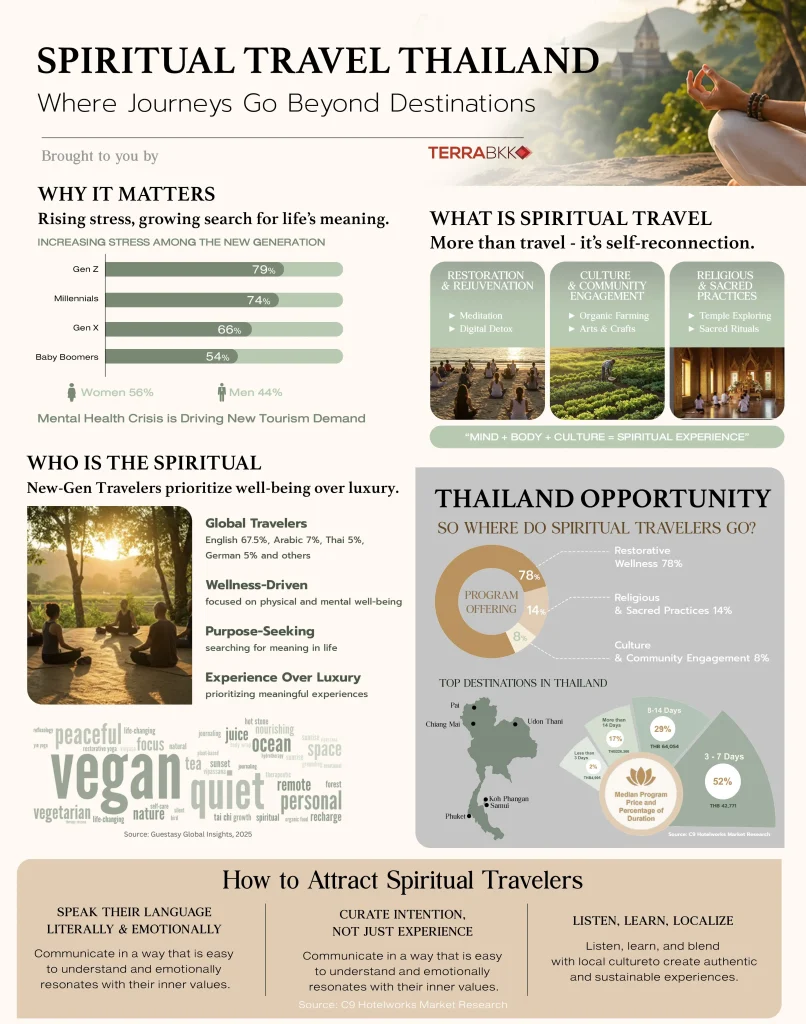
Thailand is increasingly being recognized as a global destination for Spiritual Travel and wellness tourism. “Restorative Wellness” serves as the primary driver of the market, accounting for nearly 78%, followed by Religious and cultural activities, which are notably important. This dynamic reflects a significant transition—from traditional religious-based tourism toward a comprehensive wellness destination that caters to modern travelers seeking relaxation, healing, and self-development within a single journey.
Consumer behavior indicates a preference for programs lasting 3–7 days, followed by 8–14 days, with a segment of travelers opting for long-term stays. The pricing structure, which increases with duration, highlights a predominantly mid- to premium-market positioning. Notably, long-stay travelers are willing to invest significantly in exchange for deeper, more transformative experiences—both physically and mentally.
Thailand’s competitive advantage lies in the diversity of its destinations, which collectively support a wide range of Spiritual Travel experiences. Northern regions such as Chiang Mai and Pai are renowned for their natural landscapes and tranquil atmosphere, making them ideal for meditation and long-term retreats. Southern destinations like Phuket, Koh Samui, and Koh Phangan serve as global wellness hubs that seamlessly blend luxury with nature. Meanwhile, northeastern provinces such as Udon Thani retain the authenticity of forest monasteries and traditional spiritual practices, appealing to those seeking genuine and immersive spiritual experiences.
From an experiential perspective, the market is driven by three core components: stays in wellness retreats or health-focused accommodations, the use of nature as a healing environment, and participation in meditation or mindfulness centers. Together, these elements form a robust ecosystem that enables Thailand to cater to a broad spectrum of travelers—from beginners to those seeking profound personal transformation. With a well-defined market structure, steadily growing demand, and strong advantages in both natural and cultural resources, Thailand is well-positioned to become a fully developed “Global Wellness & Spiritual Hub” in the near future.
For operators, attracting Spiritual Travelers requires more than simply offering tourism products. It demands the ability to “communicate with the mind and heart” of travelers—both linguistically and emotionally—while designing experiences with clear intention, rather than superficial activities. Equally important is the adaptation of services to local contexts (localization), ensuring an authentic sense of connection.
Ultimately, Spiritual Travel is not a passing trend, but a reflection of a deeper societal shift in which individuals are placing greater value on their “inner quality of life.” Thailand, endowed with rich natural resources, cultural heritage, and deeply rooted spiritual traditions, holds strong potential to emerge as a global center for spiritual tourism—provided it can effectively develop and communicate these values with clarity and depth.