
NEWS & EVENTS
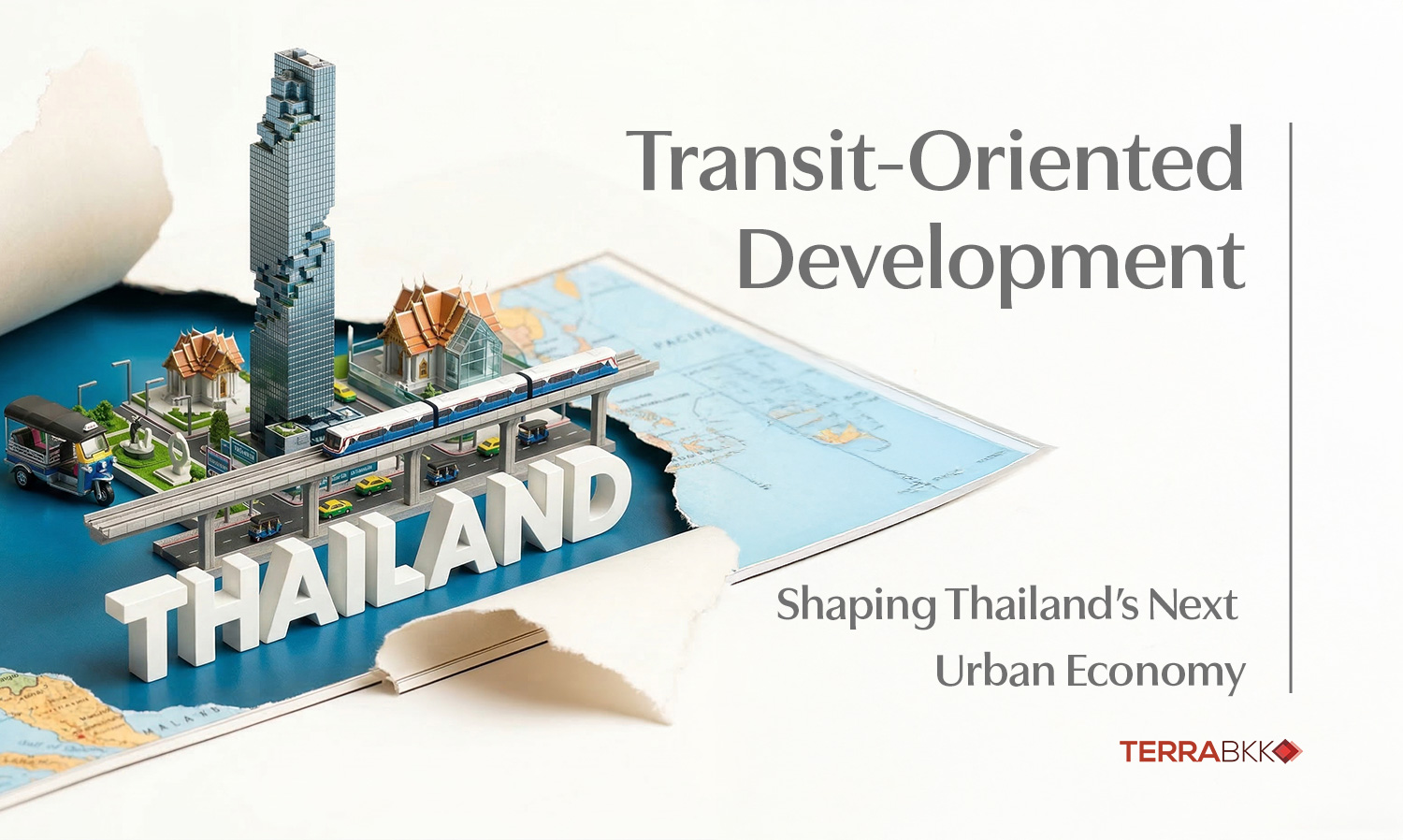
Thailand’s Action Plan for Urban Development under the Transit-Oriented Development (TOD) concept (2025–2042) represents one of the most significant infrastructure policies in recent decades. For the first time, “urban development” is being developed in tandem with “rail network” at a national scale. This is not just about expanding the transportation networks—it is about redefining how cities grow, shaping new living schemes that are more structured, efficient, and sustainable.
The core of this project lies in the transformation of areas around the stations into integrated urban transportation centers that combine residential, commercial, and economic functions in one place. The initiative covers 177 stations nationwide, including double-track railways and high-speed rail systems, and put TOD as a foundational framework for future urban development.
The implementation is divided into four phases, aligned with infrastructure readiness and real estate market dynamics. The implementation begins with an urgent phase (2025–2027) covering three pilot areas, which serve as sandboxes. The next phase continues on 80 areas (2028–2032), followed by 54 areas in the following phase and 40 areas afterward, with full nationwide implementation targeted by 2042.
Pattaya: From Tourism City to a Global Lifestyle & Business Hub
The TOD development in Pattaya is being elevated into a “regional economic hub,” strategically connected to key national infrastructures. This includes the high-speed rail linking three major airports and developments within the Eastern Economic Corridor (EEC).
The vision is to create a “new city around the station” within a radius of approximately 1,000 meters, based on a mixed-use concept that seamlessly integrates work, living, and lifestyle. The development encompasses business districts, office spaces, retail centers, hotels, MICE facilities, diverse residential options, and public spaces—effectively transforming Pattaya from a tourism-driven city into a Global Lifestyle & Business Hub with stronger economic significance.
With a total development area of approximately 1.6 million square meters, the project is structured into three phases:
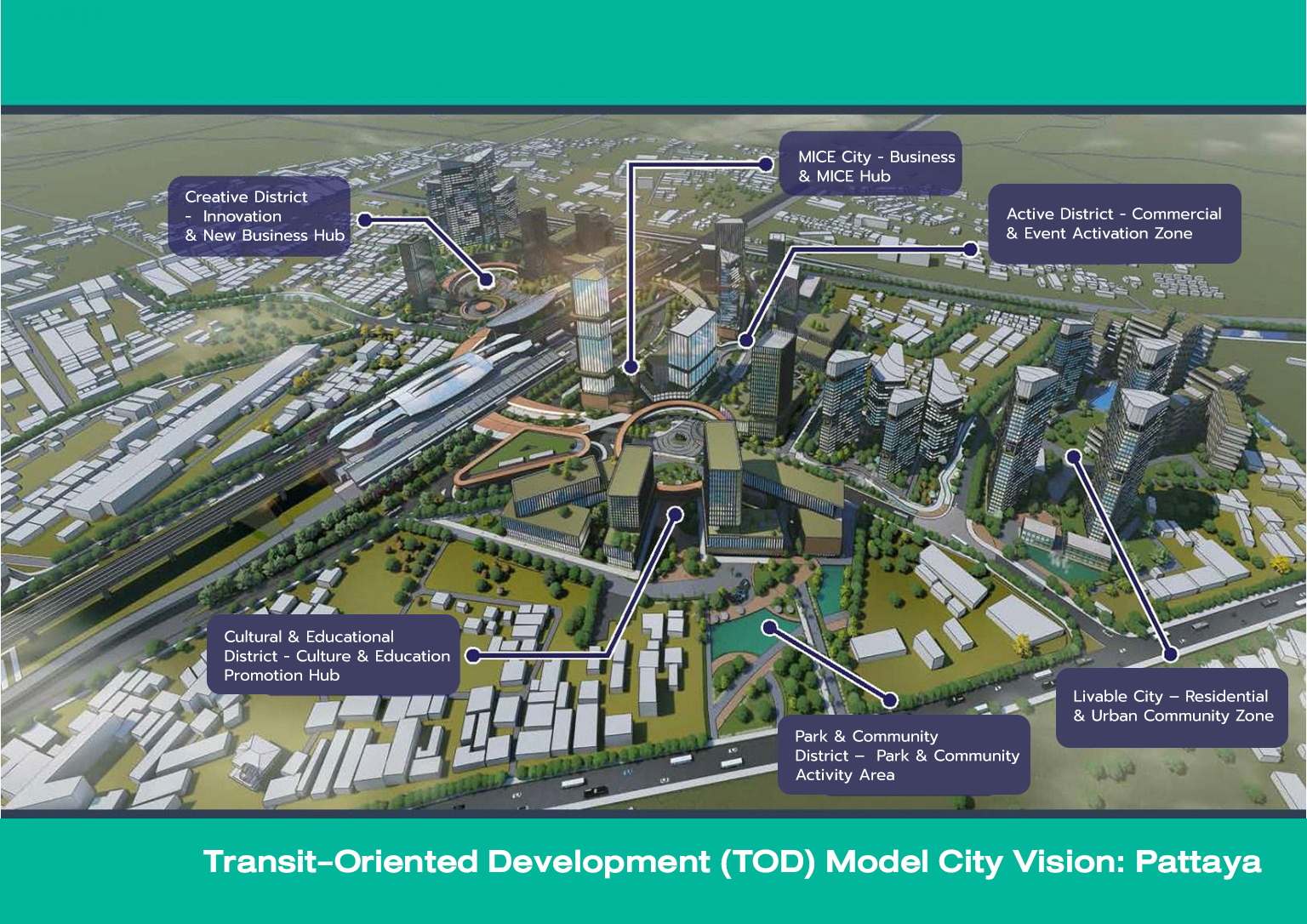
- Phase 1 (2026–2029): Focus on building core infrastructure, including roads, connectivity networks, and pedestrian and cycling networks. Key economic zones such as convention centers and business districts will be initiated to attract early investment.
- Phase 2 (2030–2034): Expand the “life of the city” by adding residential areas, green spaces, and office developments, while integrating new economic zones with existing communities to create a balanced urban ecosystem.
- Phase 3 (2035–2039): Evolve into a fully developed city supporting commerce, services, and residential life, with enhanced transport systems, accessibility, universal design, and sustainable infrastructure.
Overall, TOD Pattaya is not simply a redevelopment of a tourism city—it is a structural transformation into an internationally connected hub where economy, tourism, and urban living converge seamlessly.
Khon Kaen: A Prototype “Economic Hub of the Northeast” on Rail Infrastructure
Under the TOD framework, Khon Kaen is positioned as the “economic center of Northeastern Thailand,” with Khon Kaen Railway Station serving as the core of a compact city model that integrates transportation, economy, and lifestyle through public transit-oriented development.
The city’s existing strengths—including education, healthcare, and cross-border trade—combined with the Light Rail Transit (LRT) project, further enhance its development potential. The total projected real estate development area is approximately 2.99 million square meters, divided into three phases:
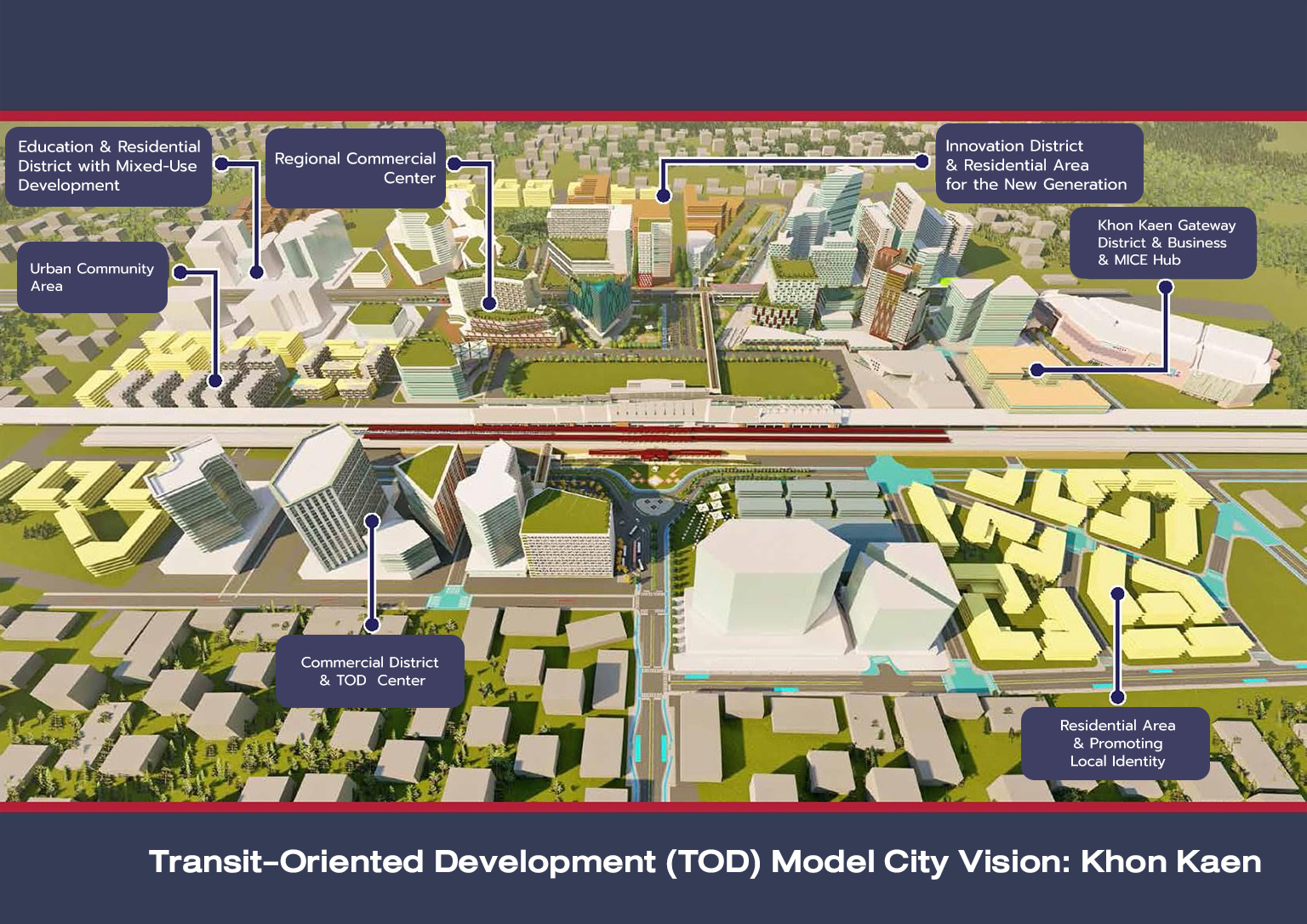
Phase 1 (2026–2029): Emphasis on trade, investment promotion, innovation development, workforce creation, and the establishment of convention and exhibition centers to stimulate early economic activity.
Phase 2 (2030–2034): Strengthen the urban fabric by adding residential developments, green spaces, and office buildings to support growing investments. Economic activities will be concentrated along key corridors such as Srichan Road and Mittraphap Road, creating a balance between work and living.
Phase 3 (2035–2039): Develop into a fully functional station-centered city, with expanded economic zones, commercial and service sectors, residential areas, green spaces, employment hubs, educational institutions, and supporting infrastructure.
TOD Khon Kaen represents a strategic elevation of the city into a regional economic hub driven by rail infrastructure—positioning the city as a future model for regional urban development in Thailand.
Ayutthaya: Balancing “Historic Preservation” and a New Economic City
The TOD development in Phra Nakhon Si Ayutthaya is designed as a model that integrates “heritage conservation” with “modern urban development.” The urgent phase (2024–2025) focuses on archaeological excavation and infrastructure preparation before full-scale real estate development begins in 2026.
The project involves private sector investment exceeding THB 26 billion, with approximately 20% allocated to commercial development—including retail centers, convention facilities, offices, hotels, and retail spaces—to drive economic activity. The remaining 80% is dedicated to residential development, including condominiums and various housing types, accommodating urban expansion across a total development area of approximately 1.16 million square meters.
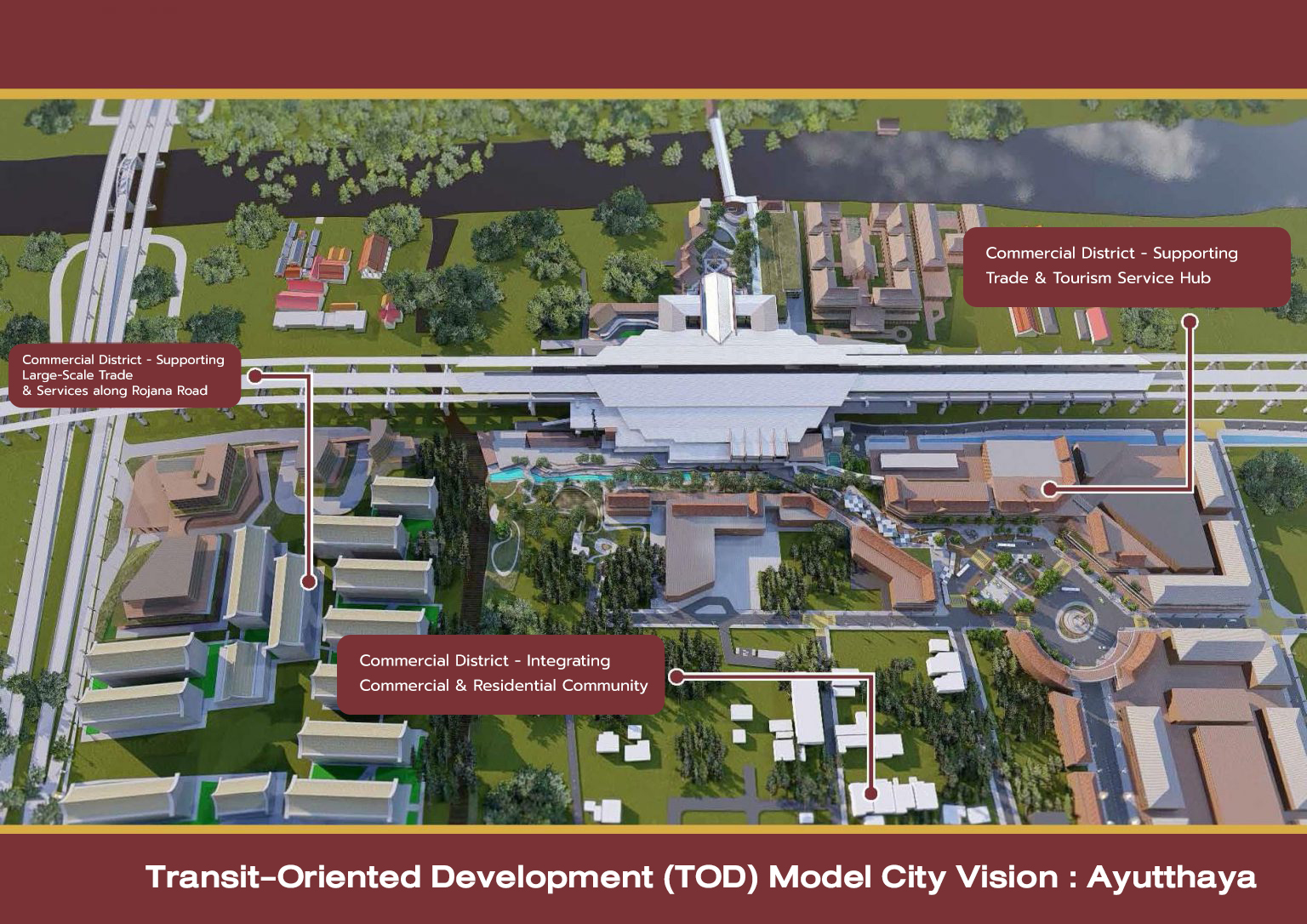
Importantly, the government also plays a role in supporting “affordable housing for low- to middle-income groups,” ensuring that TOD development in Ayutthaya remains inclusive and accessible. At the same time, urban planning prioritizes the preservation of the city’s UNESCO World Heritage identity while fostering new economic growth—creating a sustainable balance between history and the future.
TOD serves as a powerful framework to restructure urban growth—promoting compact development, reducing urban sprawl, and creating new economic centers that distribute opportunities beyond primary cities to secondary ones.
It enhances quality of life by improving access to public transportation, reducing traffic congestion and cost of living, while integrating Smart City technologies to improve urban management efficiency.
Ultimately, TOD is not just an infrastructure strategy—it is a transformative framework that reshapes both cities and economies, paving way for sustainable, inclusive, and future-ready urban development in Thailand.
RELATED ARTICLES

“Building a Rental Portfolio” Strategy: Winning Over Expats Amidst the Real Estate Downturn

Bangkok-Phuket-Samui : The Global Elite’s New Geopolitical Safe Haven

What to Buy? Which Thai Real Estate Segment is “The Right One” During the Unpredictable Times