.png)

Co-Working Spaces Aren’t Just Desks — They’re A Smart Choice for Businesses Tightening Their Belts to Thrive Stronger
Thailand’s co-working spaces are thriving as businesses embrace flexible work, lower costs, and stronger collaboration.

Co-Working Spaces Aren’t Just Desks — They’re A Smart Choice for Businesses Tightening Their Belts to Thrive Stronger
Is the Office Really Disappearing? This question may sound exaggerated — but in today’s business world, the answer is that the traditional office is changing forever.
In the time of economic uncertainty, businesses are switching to “belt-tightening mode.” As a result, the modern working model has transformed to Hybrid Work and Remote First models — primarily because they’re more cost-effective.
This is exactly why Co-Working Spaces have become the go-to choice for many Thai businesses today.
What are the driving forces that keep this sector thriving amid an economic slowdown? And why choosing a shared workspace has become a smart move — not just for well-established large corporations, but also for emerging and starting businesses?
Are Big Offices Still Necessary?
When technology breaks the geographical boundaries, work no longer needs to be confined within four walls in the middle of the city.
A few years ago, the global pandemic proved that productivity doesn’t depend on the number of hours spent at an office desk — but rather on flexibility and the right environment.
Many businesses today no longer require large offices. Many organizations are beginning to downsize their office spaces as rental costs in central business districts (CBDs) soar — including rent, utilities, maintenance fees and employee commuting expenses. Starting an era when work can be done from virtually anywhere.
This is where Co-Working Spaces step in by offering “Space as a Service” — a model of workspace that helps reduce fixed costs, provides flexibility to scale space up or down as needed, and fully supports the hybrid working lifestyle.
More Than an Office — A Space That Inspires
Aside from cost and commuting concerns, Co-Working Spaces in Thailand are driven by factors that cater specifically to the needs of modern workers and innovative businesses. Those factors include:
[1] Building a Strong Ecosystem and Community:
This is a core advantage that traditional offices cannot provide. Many pioneering Co-Working Spaces in Thailand (such as Hubba or True Digital Park) don’t just sell workspace—they sell business opportunities through networking. By bringing together freelancers, startups, and SMEs from various industries under one roof, these spaces foster idea exchange, business partnerships, and the creation of an ecosystem that supports innovation.
[2] Attracting and Retaining Talent:
Young employees, particularly Gen Y and Gen Z, place high value on work-life balance and flexibility. Co-Working Spaces with thoughtful design, comprehensive amenities (e.g., lounge areas, cafés, event spaces), and a creative atmosphere serve as an indirect benefit that helps organizations attract and retain top talent.
[3] Specialized Facilities:
Co-Working Spaces often provide specialized equipment and spaces that startups or freelancers may not be able to afford on their own. Examples include high-quality video conference rooms, podcast studios, or even labs for prototype development. These facilities enhance productivity and support specialized business needs.
Co-Working Space: Expanding to Meet New Demand
Even as the economy slows, the demand for shared workspaces continues to grow steadily as seen in the ongoing expansion of both major and smaller operators, choosing Thailand as a key hub for establishing co-working spaces in Southeast Asia. This confirms that the co-working space business can “still move forward” even in a belt-tightening era:
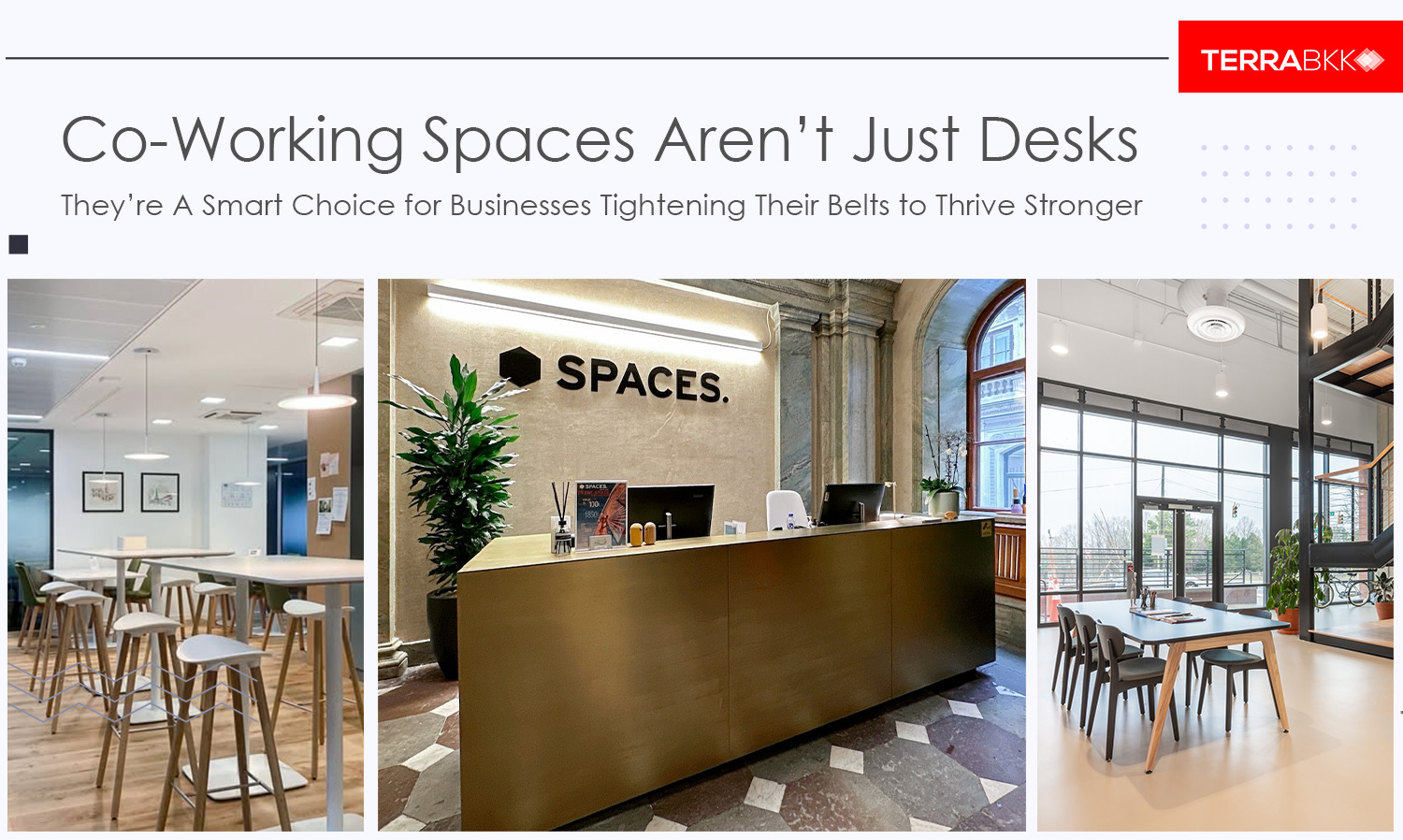
- IWG (Regus & Spaces): A global player focusing on CBD locations (Sathorn, Ploenchit, Sukhumvit) in Grade A buildings to attract multinational companies and large organizations seeking the highest standards. They also expand to key regional cities such as Phuket, Chonburi, Rayong, Pattaya, and Samut Prakan.
- JustCo: A major provider from Singapore, focusing on Grade A office locations in the city center, such as One City Centre and Sathorn Square. With a strong international network, it is suitable for large companies seeking high flexibility.
- The Hive: With many branches across Asia, its strength lies in building strong communities (emphasizing activities) and connections. Branches are often located in lifestyle zones such as Thonglor and Sukhumvit.
- Common Ground: Another international operator, mainly focused on community building and modern design to attract Gen Y and digital nomads.
- Local operators: In addition to global brands, Thai operators and smaller players are also growing strongly, focusing on “unique differentiators,” such as: Design and lifestyle focus: Catering to creative workers and startup; Suburban locations: Catering to employees who prefer working closer to home; Community focus: Building networks for niche business groups, such as tech, marketing, or digital nomads
The growth of co-working spaces in Thailand continues to expand into residential areas and new commercial hubs to serve hybrid workers who want to reduce commuting time. Examples include:
- Digital nomad centers such as Bangkok, Nakhon Ratchasima, Chiang Mai (Nimmanhaemin, Old town), and Phuket (Patong, city center), where most demand comes from global remote workers. These cities are ranked among popular destinations for digital nomads.
- Bangkok suburbs/peripheral areas such as Bangna (near shopping centers), Rattanathibet, and Rangsit, where demand comes from employees living in the suburbs who prefer to work closer to home, reducing commuting costs and travel time to the CBD.
- New commercial hubs such as Asoke–Rama 9 and locations near public transit systems, where demand comes from corporate downsizing. Large organizations are relocating from high-rent CBD areas to non-CBD locations with new Grade A office buildings to save on rental costs while still maintaining convenient access to public transport.
Variety of service offerings
Services offered in co-working spaces in Thailand have evolved beyond just providing desks. Interesting services have emerged to cater for more types of customers. The services can be broadly categorized into the following groups
Service type
Target group
Pay-per-use & Day Pass
Freelance and regular employees. Pay for hourly or daily use.
Virtual Office
SMEs and startups that need a registered business address, mail/phone handling services without renting a physical space, and need to reduce fixed costs.
Dedicated Enterprise Suite
Customizable Office for organizations that need privacy while still utilizing shared services and reducing building management and maintenance.
Pet-Friendly Workspaces
Workspaces that allow pets for modern workers who value balancing their work and their own and their pets’ well-being.
Thailand’s Co-Working Space Can “Keep Moving Forward”
Thailand’s economic continues to welcome tourists and foreign investment, the co-working space industry still has room to grow, driven by several positive factors, such as:
- Driven by Digital Nomads and Global Remote Workers: Thailand is ranked as one of the most popular countries for digital nomads due to the relatively low cost of living compared to neighboring countries, high quality of life, and natural beauty.
- Growth of new visa programs: Government policies supporting long-term visas for skilled individuals and remote workers have significantly increased the number of people seeking professional workplaces.
- Transition in the office real estate market: Traditional office rental markets are facing oversupply in many areas of Bangkok. Large building owners are adapting by allocating portions of their space to co-working operators or launching their own flexible spaces (Flex Space) to increase occupancy rates and mitigate risk.
- Investment in “Community” and “Well-being”: Modern co-working spaces no longer just have desks, chairs, and Wi-Fi—they offer community and work-life balance. This includes organizing seminars and workshops to create business opportunities for members. These are something not available when working from home. Well-being-focused designs, such as relaxation zones, quiet zones, kitchen areas, and even pet-friendly spaces, have become major selling points that attract modern workers.
New Models in the Era of Flexibility
Co-working spaces in Thailand have adapted to more diverse and specialized business models, such as:
Business model
Opportunity
Co-Living & Co-Working
A model that integrates living spaces with workspaces, catering to digital nomads and employees who want to change their work environment on a weekly or monthly basis, especially in tourist hubs such as Phuket and Chiang Mai.
Thematic Co-Working
Workspaces targeting specific groups, such as FinTech Hubs, Gaming/E-Sport Centers, or Creative & Art Studios, to build strong communities and attract long-term tenants.
Subscription Model for Enterprises
Selling access passes to organizations without fixed desks, allowing employees to use any branch within the network at their convenience, increasing flexibility for companies with distributed teams.
Suburban Hubs
Opening branches in suburban areas or shopping centers near residential neighborhoods to reduce employees’ commuting time and allow them to use their free time more productively for work.
Entering a belt-tightening era does not mean businesses will stop growing; it means they need to “work smarter” and “invest in flexibility.” Ultimately, co-working spaces are not just a temporary trend—they have become an integral part of foundational business strategies in an era of high uncertainty.
Subscribe to our newsletter
Stay up to date with Angel RE news and pre launch offers